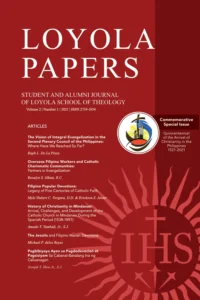
Loyola Papers Vol. 2 No. 1 (2021)
When the Spaniards came to these islands on March 16, 1521, it only took them less than a month before they could have their first converts. On April 14 of the same year, Rajah Humabon and his wife Amihan, with some 800 of his subjects, were baptized in Cebu, on which occasion the Santo Niño was given to his wife as a present. However, it would appear that the roots planted were not so deep. Less than a couple of weeks later, after the Spaniards failed to defeat his rival, Lapu-Lapu, Humabon tried to poison the remainder of the fleet and presumably reverted to his old religion. The next expedition in 1565 would find the image of the Santo Niño tucked away in a wooden box. Thus, while it seemed so easy to make Filipinos Christians, it was not so easy after all to make them Christian.
Articles
- The Vision of Integral Evangelization in the Second Plenary Council of the Philippines (1–28)
- Overseas Filipino Workers and Catholic Charismatic Communities (29–58)
- Filipino Popular Devotions (59–74)
- History of Christianity in Mindanao (75–106)
- The Jesuits and Filipino Marian Devotions (107–154)
- Pagbibiyaya Ayon sa Pagdedevocion at Pagsisiyam Sa Cabanal-Banalang Ina ng Caliuanagan (155–188)